


How to Read Your Human Design Chart for the First Time
The first time you look at your Human Design chart, the symbols and shapes may appear mysterious or overwhelming. Yet behind the visual complexity lies a surprisingly intuitive map that reveals how your energy naturally operates.
Opening the Bodygraph for the First Time
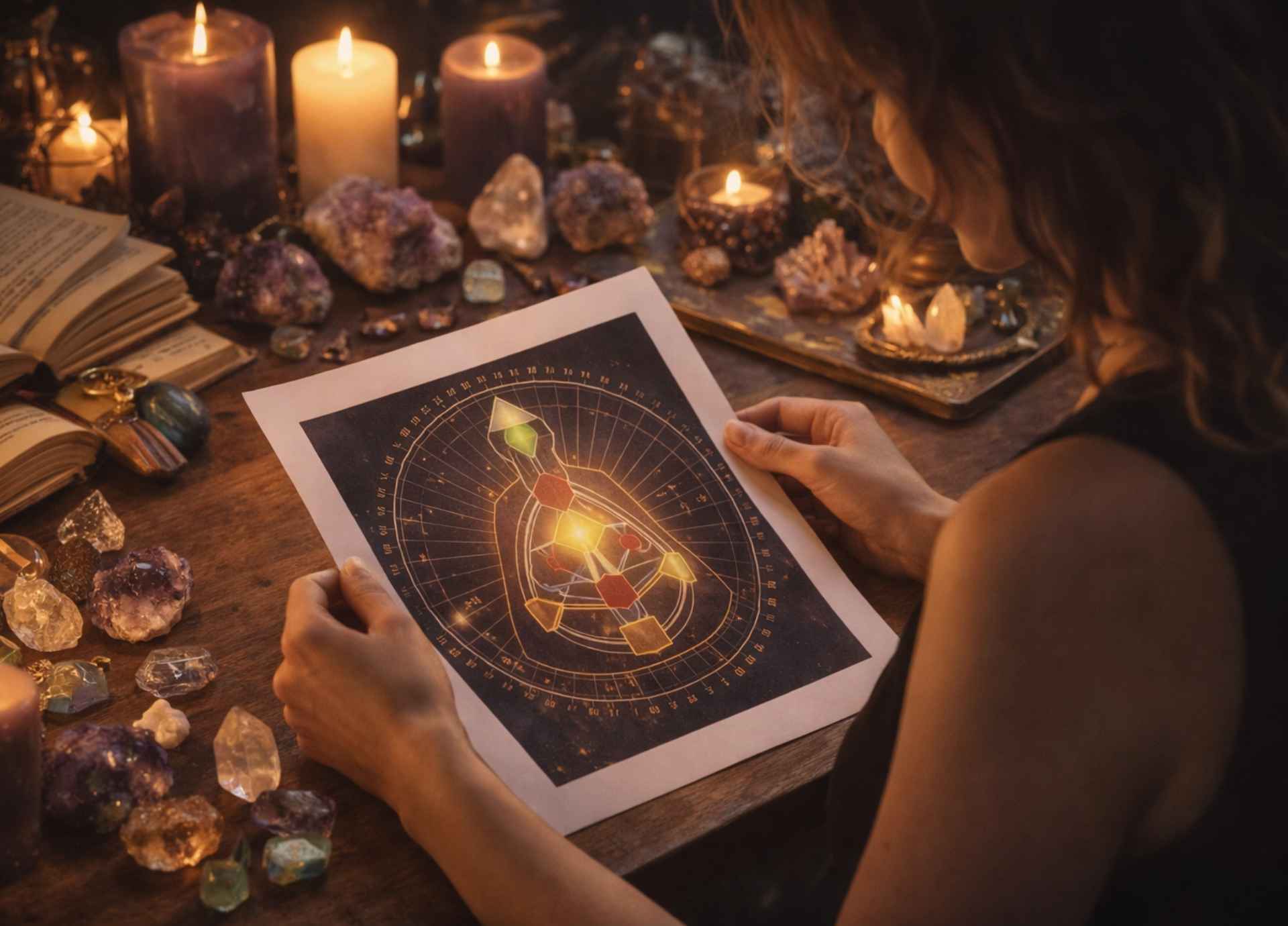
When people generate their Human Design chart for the first time, they often encounter a diagram filled with geometric shapes, numbers, and lines connecting different centers.
This diagram is called the Bodygraph.
It represents the energetic structure of your being, calculated using your birth date, time, and location. Rather than acting as a personality test or predictive system, the chart functions as a map that reveals how your life force flows through the body.
Learning to read a Human Design chart does not require mastering every symbol immediately. In fact, the most effective approach is to begin with the foundational elements that shape your energetic design.
These key components offer the clearest insight into how your energy engages with the world.
Human Design Beginner’s Guide: Understanding Your Energy Blueprint
Step One: Identify Your Energy Type
The first element to explore in your chart is your energy type. Your type describes how your life force interacts with opportunities, people, and experiences.
Human Design recognizes five primary energy types:
Manifestor
Initiators of movement who bring new ideas and directions into the world.
Generator
Individuals with powerful life force energy who build, create, and sustain momentum.
Manifesting Generator
Dynamic energy types who combine rapid action with sustained creative force.
Projector
Guides who naturally perceive how energy flows within systems and people.
Reflector
Rare individuals whose openness allows them to mirror the health of their environment.
Your type provides the foundation for understanding how your energy is designed to interact with life.
Step Two: Understand Your Strategy
Once you know your energy type, the next element to observe is your strategy.
Strategy describes how your energy most naturally responds to opportunities. When individuals follow their strategy, life often begins to unfold with greater ease.
Each type has its own natural strategy.
Manifestors benefit from informing before taking action.
Generators and Manifesting Generators often thrive when they respond to what life presents.
Projectors tend to flourish when they wait for recognition or invitation.
Reflectors benefit from giving themselves time to observe cycles before deciding.
Strategy is less about controlling outcomes and more about recognizing how your energy prefers to move.
Step Three: Discover Your Authority
Authority refers to the place within your body where reliable decisions emerge.
While many people are taught to rely primarily on the mind when making choices, Human Design suggests that clarity often arises from deeper bodily signals.
Different people experience decision-making guidance through different internal centers.
Some feel clarity through emotional waves that settle over time.
Others experience immediate intuitive responses within the body.
Authority reveals where your most trustworthy decision-making process resides.
Step Four: Observe the Energy Centers
The shapes within your Human Design chart represent nine energy centers. Each center corresponds to a different aspect of perception and experience.
These centers influence areas such as inspiration, identity, communication, emotions, intuition, and life force energy.
When a center is defined, it appears colored in the chart and tends to operate consistently throughout your life.
When a center is undefined, it appears white and is more receptive to the energy of the surrounding environment.
Neither defined nor undefined centers are inherently positive or negative. Instead they simply show where your energy is stable and where it is more fluid.
Step Five: Notice Channels and Gates
Connecting the centers in the Bodygraph are lines called channels.
Channels represent energetic pathways that allow centers to communicate with one another. Each channel is formed by two gates, which originate from the sixty four archetypal energies of the I Ching.
Defined channels reveal consistent themes in the way your talents, instincts, and patterns express themselves.
These pathways add depth and nuance to the overall structure of your energetic design.
Bringing the Chart Into Daily Life
Reading a Human Design chart is not simply an intellectual exercise. Its value appears most clearly when its insights are observed in everyday life.
You may begin to notice patterns in how your energy responds to opportunities, relationships, or environments.
Some situations feel naturally energizing and aligned.
Others may feel forced or draining.
These experiences often reflect the ways your energy is interacting with the world around you.
Human Design encourages curiosity about these patterns rather than rigid interpretation.
Working With Your Chart Over Time
The Human Design system contains many layers, and understanding them is a gradual process.
A helpful approach is to focus first on three foundational elements:
- Your Energy Type
- Your Strategy
- Your Authority
Together these form the core guidance of your energetic design.
As familiarity grows, deeper elements such as profiles, centers, and channels begin to offer additional insight.
Like any map, your chart becomes clearer the more you explore it.
Reflection
Take a moment to reflect on your experience as you explore your chart.
- What aspects of your energy feel consistent throughout your life?
- In which situations do you feel most naturally aligned?
- Where do you notice tension or resistance appearing?
Observing these patterns can gradually reveal how your energy is designed to operate.
Closing Reflection
A Human Design chart is not a puzzle that must be solved immediately.
Instead, it is an invitation to observe the unique energetic architecture that already exists within you. Over time, that awareness can bring a deeper sense of alignment with your natural rhythm and direction.
Post a Comment